
Full-Arch Dental Implants in Geneva, IL
Patients who are missing all or most of their upper teeth, lower teeth, or both have several implant-supported treatment options. Dental implants can stabilize a removable denture or support a fixed full-arch restoration that remains in place between professional maintenance visits.
At Illinois Oral & Maxillofacial Surgery, Kevin R. Haddle, MD, DDS, performs the surgical portion of full-arch implant treatment for patients from Geneva, St. Charles, Batavia, and surrounding Fox Valley communities. He coordinates with the patient’s restorative dentist, who designs and creates the final replacement teeth.
Quick Answer: How Can All Upper or Lower Teeth Be Replaced?
An entire arch of missing teeth can be replaced with a conventional denture, an implant-retained removable overdenture, or a fixed full-arch restoration supported by dental implants. The recommended option depends on the available jawbone, number and position of implants, desired stability, cleaning requirements, health history, and restorative goals.
What Are Full-Arch Dental Implants?
Full-arch dental implant treatment uses multiple implants to support replacement teeth across an entire upper or lower jaw. Unlike a single-tooth implant, one implant is not necessarily placed for every missing tooth. A carefully planned group of implants can support a removable overdenture or a fixed restoration that replaces the full arch.
Full-arch treatment may be considered for patients who:
- Are missing all teeth in the upper or lower jaw
- Have several failing or non-restorable teeth
- Have difficulty wearing a conventional denture
- Want greater denture stability
- Are interested in a fixed alternative to removable teeth
- Have sufficient bone or are candidates for appropriate grafting
Patients still comparing their options can review our guide to replacing missing teeth.
How Is a Full-Arch Treatment Plan Developed?
Planning begins with an oral examination, health-history review, evaluation of the remaining teeth, and diagnostic imaging. When clinically appropriate, 3D cone beam CT imaging helps Dr. Haddle evaluate bone dimensions, sinus anatomy, nerve locations, and potential implant positions.
The surgical and restorative providers consider:
- The condition of the remaining teeth and gums
- Jawbone height, width, density, and shape
- The number and distribution of implants needed
- Whether the restoration will be removable or fixed
- Facial and lip support
- Bite forces and available restorative space
- Ability to clean beneath and around the restoration
- Whether tooth extraction or bone grafting is necessary
- The patient’s health, medications, and healing risk factors
Options for Replacing All Lower Teeth
Lower dentures can be difficult to stabilize because the tongue, cheeks, and jaw movements place forces on the appliance. Dental implants can provide attachment points that reduce movement and improve retention.
Two-Implant Retained Lower Denture
One option uses two implants in the lower jaw to retain a removable overdenture. Attachments inside the denture connect to the implants and help it remain more stable than a conventional lower denture.
The denture is removed by the patient for cleaning. Some movement may still occur because portions of the appliance continue to rest on the gum tissue. Periodic maintenance may include attachment replacement, relining, and denture adjustments.
Bar-Retained Lower Overdenture
A bar-retained overdenture uses several implants connected by a custom support bar. Retentive components inside the denture attach to the bar, providing additional stability and distributing forces across the implants.
The restoration remains removable, which allows the patient to clean the denture, attachments, bar, gums, and implant sites. The number of implants required depends on the jaw anatomy, bone availability, restoration design, and planned attachment system.
Learn more about removable implant-supported overdentures.
Fixed Screw-Retained Lower Restoration
A fixed full-arch restoration is secured to multiple implants with prosthetic screws. It remains in place during daily activities and is removed only by a dental professional when maintenance or repair is necessary.
Although the patient does not remove the restoration, the space beneath it must be cleaned carefully with tools recommended by the restorative team. The number and position of implants are determined by the available bone, biting forces, restoration design, and other clinical factors.
Individual Implant Crowns and Implant Bridges
Some patients may be candidates for several individual implants or implant-supported bridges that more closely divide the arch into separate sections. This approach generally requires more implants, restorative components, and available bone than other full-arch options.
One implant is not always needed for every missing tooth. The surgical and restorative providers determine whether individual crowns, segmented bridges, or another full-arch design is appropriate.
Options for Replacing All Upper Teeth
The upper jaw presents different anatomical and restorative considerations than the lower jaw. Bone density, available bone beneath the maxillary sinuses, lip support, speech, and the shape of the palate can all influence the recommended treatment.
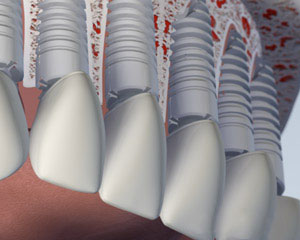
Implant-Supported Full-Arch Upper Restoration
Multiple implants can support a removable or fixed upper-arch restoration. The accompanying video demonstrates a full-arch treatment concept using four strategically positioned implants. The actual number and position of implants must be individualized for each patient.
Depending on the design, an implant-supported upper restoration may reduce or eliminate coverage across the roof of the mouth. This can provide a less bulky design than a conventional upper denture, but anatomy and restorative requirements determine what is possible.
Individual Upper Implants or Segmented Implant Bridges
Selected patients may receive several individual implant crowns or implant-supported bridges divided into sections. This approach can create a fixed restoration, but it generally requires adequate bone, sufficient restorative space, and a greater number of implants and components.
The upper jaw does not automatically require a fixed number of implants. Dr. Haddle and the restorative dentist determine the appropriate number based on bone quality, implant distribution, biting forces, and prosthetic design.
What Is the Difference Between Removable and Fixed Full-Arch Teeth?
Removable Implant Overdenture
A removable overdenture attaches to implants but is taken out by the patient for daily cleaning. Potential benefits include easier access for hygiene, improved retention compared with a conventional denture, and the ability to replace lost gum tissue and provide facial support through the prosthesis.
Maintenance may include replacing attachment components, adjusting the bite, relining the denture, or repairing worn prosthetic teeth.
Fixed Full-Arch Restoration
A fixed restoration is secured to the implants and is not removed by the patient. It generally provides greater stability and may feel more similar to fixed teeth, but cleaning beneath the restoration requires specialized techniques and consistent professional maintenance.
Neither design is automatically better for every patient. Bone anatomy, hygiene ability, lip support, hand dexterity, restorative space, treatment cost, and personal preferences all influence the recommendation.
Can Failing Teeth Be Removed and Replaced During the Same Procedure?
In appropriate cases, remaining teeth can be removed, implants placed, and a temporary full-arch restoration attached during the same treatment sequence. This is sometimes described as immediate full-arch treatment.
Immediate temporary teeth depend on:
- Adequate implant stability at surgery
- Sufficient bone in appropriate locations
- The absence or controlled management of infection
- A favorable distribution of implants
- A carefully designed temporary restoration
- The patient’s ability to follow a modified diet and postoperative instructions
Not every patient qualifies for an immediate temporary restoration. In some cases, a removable temporary denture is used while the implants heal.
Will Bone Grafting Be Necessary?
Bone grafting is not required for every full-arch implant case. Some treatment plans can use available bone in strategic areas, while others require additional bone to establish adequate implant support.
Bone grafting for implants may be recommended when:
- The jaw ridge has become too narrow or short
- Teeth have been missing for an extended period
- Gum disease or infection has damaged supporting bone
- A previous denture has contributed to progressive ridge changes
- The upper sinus limits available posterior bone
- An extraction site needs to be preserved or rebuilt
For upper posterior implant sites, a sinus lift may be considered. The need for grafting is determined through examination and imaging rather than solely by the number of missing teeth.
What Is the Full-Arch Dental Implant Process?
The treatment sequence varies, but it commonly includes:
- Consultation and imaging: Dr. Haddle evaluates the jawbone, remaining teeth, health history, and surgical needs.
- Restorative planning: The restorative dentist designs the temporary and final replacement teeth with input from Dr. Haddle.
- Site preparation: Remaining failing teeth may be extracted, and bone grafting may be completed when necessary.
- Implant placement: Dr. Haddle positions the planned implants in the jawbone.
- Temporary teeth: An appropriate fixed or removable temporary restoration may be provided.
- Healing: The implants integrate with the surrounding bone while the surgical team monitors recovery.
- Final restoration: The restorative dentist creates and places the definitive prosthesis.
- Maintenance: The patient attends ongoing hygiene, restorative, and implant-evaluation appointments.
Visit our dental implant placement page for more information about the surgical procedure.
What Anesthesia Options Are Available?
Local anesthesia is used to numb the surgical areas. Additional sedation or anesthesia options may be available depending on the number of extractions, extent of implant surgery, grafting, medical history, and patient comfort needs.
As an oral and maxillofacial surgeon, Dr. Haddle completed hospital-based surgical and anesthesia training. The recommended anesthesia plan is discussed before treatment.
How Long Does Full-Arch Treatment Take?
The timeline depends on the number of remaining teeth, whether grafting is required, implant stability, healing response, and the type of temporary and final restoration. Some patients can receive temporary teeth during the initial surgical phase, but the implants and surrounding tissues still require time to heal.
The final restoration is generally completed after the surgical and restorative teams determine that the implants and tissues are ready. Patients can review additional healing and maintenance information on the after implant placement FAQ page.
How Are Full-Arch Restorations Maintained?
Implant-supported teeth require daily cleaning and ongoing professional care. Maintenance varies according to whether the restoration is removable or fixed.
Patients may need to:
- Brush the restoration and implant areas daily
- Use floss threaders, interdental brushes, or a water-flossing device as instructed
- Remove and clean an overdenture each day
- Clean beneath a fixed restoration
- Attend professional hygiene and implant-maintenance visits
- Have attachments, screws, prosthetic teeth, or other components periodically adjusted or replaced
How Much Do Full-Arch Dental Implants Cost?
The cost varies according to the number of implants, tooth extractions, grafting, anesthesia, temporary teeth, final prosthesis, laboratory work, and maintenance requirements. Removable and fixed restorations also have different surgical and restorative costs.
Dr. Haddle’s surgical services and the restorative dentist’s prosthetic services may be billed separately. Visit the cost of dental implants page for additional information.
Why Choose an Oral and Maxillofacial Surgeon?
Full-arch implant treatment may involve multiple extractions, bone grafting, implant placement, anesthesia, and careful evaluation of facial and jaw anatomy. Oral and maxillofacial surgeons receive hospital-based training focused on these surgical areas.
Dr. Kevin Haddle earned both DDS and MD degrees and is dual board-certified by the American Board of Oral and Maxillofacial Surgery and the American Board of Cosmetic Surgery. His training supports comprehensive surgical planning for straightforward and complex implant cases.
Frequently Asked Questions About Full-Arch Dental Implants
How many implants are needed to replace a full arch of teeth?
The number varies according to the jawbone, restoration type, implant distribution, biting forces, and other clinical considerations. Some restorations may use as few as two implants for retention, while fixed or more extensively supported restorations generally require additional implants.
Are full-arch implant teeth removable?
They can be removable or fixed. An overdenture is removed by the patient for cleaning, while a fixed restoration remains attached and is removed only by a dental professional when necessary.
Can I receive full-arch implants if I already wear dentures?
Possibly. Existing denture wearers can be evaluated for implant-retained or fixed treatment. Candidacy depends on bone availability, health history, restorative space, and other clinical factors.
Can I have temporary teeth on the day of implant surgery?
Some patients qualify for an immediate temporary restoration. Others use a modified or newly created removable denture while the implants heal. The decision is based on implant stability and the overall treatment plan.
Do full-arch dental implants require bone grafting?
Not always. Some patients have sufficient bone for implant placement without grafting, while others need ridge augmentation, socket grafting, or a sinus-related procedure.
Do fixed full-arch teeth require maintenance?
Yes. Fixed restorations require daily cleaning beneath and around the prosthesis, professional hygiene visits, implant evaluations, and occasional repair or replacement of prosthetic components.
Explore Related Dental Implant Resources
- Dental Implants in Geneva, IL
- Compare Tooth Replacement Options
- Dental Implant Placement Procedure
- Implant-Supported Overdentures
- Bone Grafting for Dental Implants
- After Implant Placement FAQ
- Cost of Dental Implants
Schedule a Full-Arch Implant Consultation in Geneva
Illinois Oral & Maxillofacial Surgery provides full-arch implant planning and surgery for patients from Geneva, St. Charles, Batavia, Aurora, North Aurora, Campton Hills, Elburn, South Elgin, Sugar Grove, Wayne, West Chicago, and surrounding Fox Valley communities.
Call the Geneva office at 630-232-9090 or request an appointment online to discuss removable and fixed full-arch tooth replacement with Dr. Haddle.
